About us
We are a group of researchers who aim at gaining a better insight into human behaviour and its underlying mechanisms in a world which becomes increasingly complex. We engage in multiple areas of human factors, such as highly automated driving, the use of collaborative robotic systems, the automation of ships, as well as AI solutions. We provide fundamental as well as more applied findings from a psychological and cognitive science perspective, with a focus on mental workload, adaptability, acceptance, and cognitive functions as well as influencing factors. Our findings create a basis for a human-centred development of new technologies and the development of measures to support the users in interacting with new systems. Our work is funded by different national and international research grants as well as various business partners.

Blog
WHAT'S NEW
11.09.2025
New Role as Speaker of the Division of Engineering Psychology at DGPs

We are pleased to share that Magnus Liebherr has been elected as the new Speaker of the Division of Engineering Psychology within the German Psychological Society (Deutsche Gesellschaft für Psychologie, DGPs) e.V.
This appointment marks an exciting step for the division. Magnus expressed his gratitude to all members for the trust placed in him and emphasized his enthusiasm for shaping the future of engineering psychology together with the newly elected board members Linda Onnasch, Johannes Kraus, Ilka Hein, and Gina Nathalie Schnücker.
In his new role, Magnus is committed to strengthening the visibility of engineering psychology, fostering interdisciplinary exchange, and providing a platform for innovative research and applied solutions. The division will continue to address central challenges at the intersection of psychology and technology, such as automation, artificial intelligence, and digitalization—always with the goal of making complex systems safer, more usable, and more human-centered. Magnus also highlighted the outstanding contributions of the previous leadership team. Special thanks go to Christiane Attig, Thomas Franke, and Steffen Hösterey, whose dedication over the past years laid the foundation for the division’s continued success. With this transition, the Division of Engineering Psychology looks forward to a period of fruitful collaboration, fresh perspectives, and continued growth. Together with the entire board and membership, the division is well positioned to drive the field forward and to contribute meaningfully to both science and practice.
08.09.2025
Insights from the AOWI 2025 - Conference on Work, Organizational, and Engineering Psychology
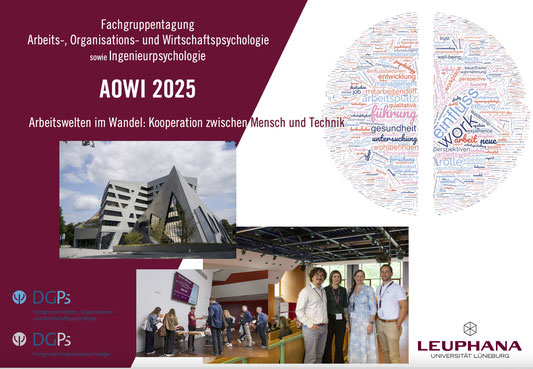
After a year of preparation, the AOWI 2025 Conference in Lüneburg brought together the Divisions of Work, Organizational, and Business Psychology and the Division of Engineering Psychology of the
German Psychological Society (DGPs) e.V. for four days of inspiring input, lively discussions, and fresh perspectives. The conference once again demonstrated the value of interdisciplinary
dialogue, particularly around pressing topics such as artificial intelligence (AI), automation, and human-technology interaction.
The program was shaped by a wide range of sessions, symposia, and interactive formats, all of which created space for exchange between researchers, practitioners, and students. A particularly
enriching aspect was the intensive debate on the identity and future of engineering psychology and its role in a rapidly changing technological landscape. We actively involved in several
parts of the conference:
- Together with Laura Venz, Franziska Josefine Kößler, and Thomas Franke, Magnus co-organizing the overall event.
- Magnus joined a panel discussion organized by Tobias Rieger, where he, alongside Annette Kluge, Linda Onnasch, Marlene Wessels, and Tim Schrills, discussed the identity and future directions of engineering psychology.
- Verena presented her work on "Automation in the Maritime Sector: The Role of Ergonomic Human–Machine Interfaces and Additional Factors Influencing Mental Workload.” Her contribution highlighted how thoughtful interface design and contextual conditions shape operator performance and well-being in highly automated environments.
- Within the symposium on Human–AI Interaction, organized by Tim Schrills and Thomas Franke, Magnus contributed with a cognitive perspective on human interaction with intelligent systems.
- The interactive forum “AI in the World of Work”, co-organized with Linda Onnasch, Johannes Kraus, Tim Schrills, and Markus Langer, attracted an overwhelming number of participants and highlighted the strong interest in the implications of AI for working life.
With its broad range of perspectives and its spirit of collaboration, AOWI 2025 provided valuable impulses for research and practice in psychology and beyond. The conference reaffirmed the importance of interdisciplinary dialogue in addressing the challenges and opportunities that arise from technological change.
The community is already looking forward to AOWI 2027, which may even take place beyond the borders of Germany
21.08.2025
Academic Milestone: Habilitation at the University of Duisburg-Essen
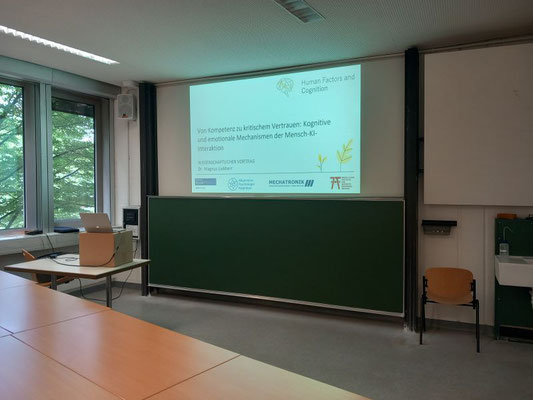
We are delighted to share a significant academic achievement:
Magnus Liebherr has successfully completed the final part of his Habilitation at the University of Duisburg-Essen, Faculty of Engineering. The process included the scientific lecture, teaching
lecture, and colloquium. With these steps accomplished, Magnus now awaits the official awarding of the title and certificate.
While this accomplishment represents an important personal milestone, it also signals the beginning of a new
chapter in research and teaching. At the core of Magnus’s academic vision lies the conviction that the human perspective must remain central to technology development.
With his Habilitation, Magnus emphasizes his responsibility to bridge the gap between science and practice. His goal is to provide insights that support academia, industry, and society in designing technologies that empower people rather than overwhelm them. Together with colleagues, students, and partners from both research and practice, Magnus looks forward to continuing this journey, exploring how humans and technology can evolve in meaningful, responsible, and human-centered ways.
Cooperations
OUR PARTNERS